Passwords Are Slowly Dying: What Businesses Need to Know About the Shift to Passwordless Security
For years, passwords have been the first line of defence for business accounts, systems and sensitive data.
The problem is… they are also one of the weakest.
Weak passwords, reused credentials and phishing attacks continue to be one of the biggest causes of cyber breaches worldwide. Even strong passwords can become vulnerable when employees unknowingly hand them over through phishing emails or fake login pages.
That’s why companies like Microsoft are accelerating the move toward a passwordless future.
With passkeys, biometrics and multi-factor authentication becoming increasingly common across Microsoft 365 and Windows 11, businesses are starting to rethink how users securely access systems and data.
Why Passwords Are Becoming a Problem
Traditional passwords create several ongoing security issues for businesses:
- Staff reuse passwords across multiple accounts
- Weak passwords are still extremely common
- Passwords can be stolen through phishing attacks
- Login credentials are regularly leaked in data breaches
- Employees often struggle to manage large numbers of passwords
Cybercriminals know this.
Rather than “hacking” systems directly, many attacks now simply trick users into giving attackers their login details.
This is why password-related attacks remain one of the most common cybersecurity threats facing businesses today.
What Does “Passwordless” Actually Mean?
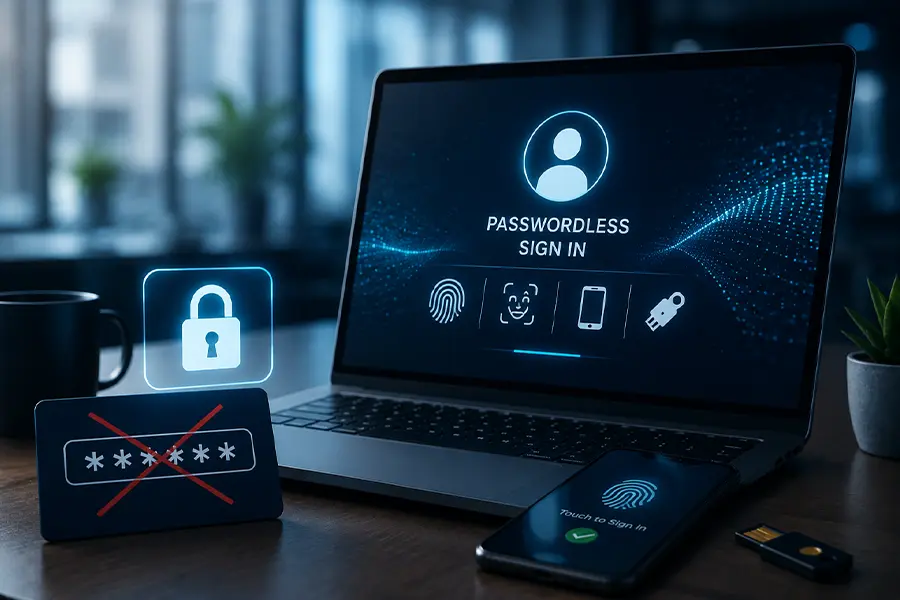
Passwordless security removes or reduces the need for traditional passwords.
Instead, users authenticate using methods such as:
- Fingerprint recognition
- Facial recognition
- Passkeys
- Authenticator app approvals
- Security keys
- Device-based authentication
Rather than relying solely on something a user knows (a password), passwordless systems use:
- Something the user has
- Something the user is
- Trusted devices and encrypted credentials
This dramatically reduces the risk of stolen passwords being used to gain access to accounts.
What Are Passkeys?
Passkeys are becoming one of the biggest developments in modern cybersecurity.
A passkey is a secure digital credential stored on a trusted device, such as:
- A smartphone
- Laptop
- Tablet
- Security key
Instead of typing a password, users simply:
- Approve a login on their device
- Use fingerprint or facial recognition
- Confirm identity securely through the device itself
Passkeys are designed to be:
- More secure than passwords
- Resistant to phishing attacks
- Easier for users to manage
- Faster to log into services
Major platforms including Microsoft, Google and Apple are all heavily supporting passkey adoption.
How Microsoft Is Driving the Change
Microsoft 365 and Windows 11 are increasingly integrating passwordless sign-in options as standard.
Businesses are being encouraged to use:
- Windows Hello
- Microsoft Authenticator
- FIDO2 security keys
- Passkey-enabled authentication
- Conditional access policies
Microsoft’s wider goal is to reduce reliance on passwords entirely over time.
For businesses, this means IT security strategies are evolving quickly.
Why Businesses Should Pay Attention
Moving toward passwordless security can provide several benefits:
Improved Security
Removing passwords significantly reduces phishing and credential theft risks.
Better User Experience
Employees no longer need to remember dozens of complex passwords.
Reduced IT Support Requests
Password reset requests remain one of the most common IT helpdesk issues.
Stronger Compliance
Modern authentication methods help businesses align with cybersecurity frameworks and insurance requirements.
Future-Proofing
As passwordless technology becomes more mainstream, businesses adopting it early may avoid rushed upgrades later.
The Challenges Businesses Still Face
While passwordless technology offers major advantages, implementation still needs careful planning.
Businesses often need to consider:
- Staff training
- Device compatibility
- Multi-device access
- Backup authentication methods
- Security policies
- Microsoft 365 configuration
- User permissions and access controls
Without proper setup, businesses can accidentally create confusion or security gaps.
How NetVector Can Help
At NetVector, we help businesses modernise their IT security with practical, proactive support.
We can assist with:
- Microsoft 365 security configuration
- MFA implementation
- Passwordless authentication setup
- Device security
- User access management
- Cybersecurity best practices
- Ongoing IT monitoring and support
As cyber threats continue to evolve, stronger authentication is becoming one of the simplest and most effective ways businesses can improve security.
Passwords are not disappearing overnight, but the industry is clearly moving toward a future where they play a much smaller role.
With phishing attacks becoming more sophisticated and AI-driven scams on the rise, businesses need stronger ways to protect accounts and sensitive information.
Passwordless technology, passkeys and modern authentication methods are quickly becoming an important part of that future.
If your business would like help reviewing its Microsoft 365 security setup or exploring passwordless authentication, we are here to help.